[ 21/02/2026 ]
Stop trying to beat gradeflation
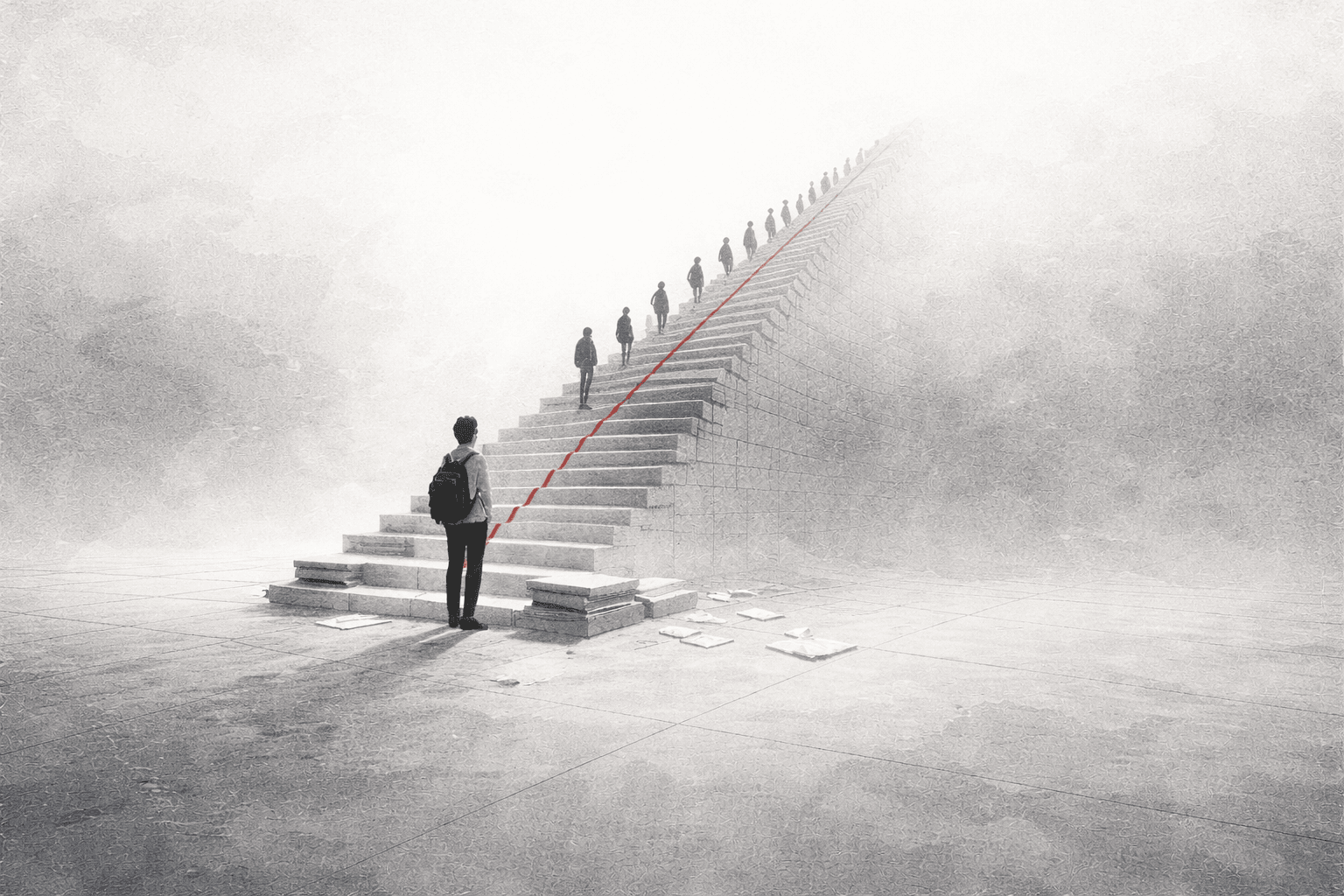
Gradeflation is very real.
Open up any exam paper from 20 years ago, check the admissions requirements for anything back in the 2000s, and you'll be thinking: "they had it so easy back then".
Nowadays, look around you and you see tutoring centres full of students, people taking extra lessons here and there. Everyone's grinding. Everyone's improving.
That's the reality of gradeflation. When a cohort of students collectively pushes harder, the bar rises because the people rise.
There's a Chinese concept called neijuan that names this feeling exactly. It's not so much a rat race as it is a cultural phenomenon of everyone striving to gain a competitive edge, and as a result, getting a 90+, getting into a top university, standing out at all, becomes harder every single year.
So what do you do? You do what any logical person does: get a tutor, work an extra few hours, push yourself to the very top. And that works, until it doesn't. It stops working because when everyone else does the same thing, every advantage disappears.
You're not alone
Everyone in your cohort has felt this. And most of them resent it: the system, the tutors, the competition, the privilege of others. But that's the wrong thing to resent.
The 2010s graduate thought the same thing. So did the 2000s graduate. So did the 1990s graduate. Every generation has gone through gradeflation. Just like how inflation quietly raises the cost of living each year, gradeflation has quietly raised the standard.
Objectively, you are more capable than any of those graduates were at your age. The curve keeps moving upwards, and yes, that means you're always running to keep up with it. But that's kind of the point. It means the floor keeps rising, and you're part of a generation that's genuinely better than the ones that came before.
This goes for parents too. Parents often push the gradeflation agenda, extra work, extra classes, because they're training their kids for the world they grew up in, where a bit of extra effort actually separated you. But the bar has moved. Every student is doing the extra work now. Pushing harder inside a system that's already saturated doesn't give kids an edge, it just exhausts them earlier.
Capability vs direction
With this in mind, you have two options. You either keep taking part in gradeflation, working longer, squeezing out every last competitive edge you have against your peers. Or you find a direction.
Gradeflation has no direction. You don't know what you're doing it for, it's painful, but you do it anyway. It gets you good grades and probably good status too, but at the expense of your time and your purpose.
Students tie their capability up with neijuan. The harder you work, the more capable you are, so they chase that endlessly. That's why everyone asks how many hours they should be studying a day. They don't want to feel left behind. But there's no finish line. The standards only ever go up, and if that's all you're running towards, you'll be running forever.
Even after school, this phenomenon persists. In uni and job applications, the same thing happens with CVs, LinkedIn profiles, internship applications. Everyone's credentials have inflated so much that the credential is no longer the differentiator. Without any direction, you're thrown into a cesspit of students all fighting to make it out, all doing the exact same things, all wondering why nothing is working.
The people who actually stand out do something different. They are still exceptionally hard workers, but their efforts go towards something specific. They don't ask whether they're studying enough because the question doesn't really come up. They already know what they're working for.
No one has ever gotten somewhere worth going by worrying about lagging behind in gradeflation. Your generation is the best it has ever been, and the worst it ever will be. The resources are there, the precedents are there. The only question is whether you're spending your energy on direction, or on anxiety.
A simple way to start thinking about it: what's the thing you'd keep working on even if nobody was grading you on it? Not a hobby, not something you feel like you should say. The thing you actually find yourself doing when nobody's watching. That's probably closer to your direction than any exam result ever will be.
A different lens
Think about it the other way. Yes, it was easier to do well back then. But knowledge and resources were far less accessible too. Imagine trying to understand calculus without a 3Blue1Brown animation to visualise it, and instead having to work through a manuscript from your local library. That's what people dealt with.
The better way to look at the past is not "they had it easier" but "look what was built with less." NASA landed on the moon with 4KB of RAM. The people who built the things you use every day had a fraction of the information, tools, and access you have right now. The floor is high, but the ceiling is practically limitless.
The people who look back on this period without regret won't be the ones who studied the hardest in that tutoring centre. They'll be the ones who figured out what they were doing all of it for. Gradeflation will keep rising regardless. The difference is whether you're being carried along by it, or actually going somewhere.
[ CONTENTS ]